|
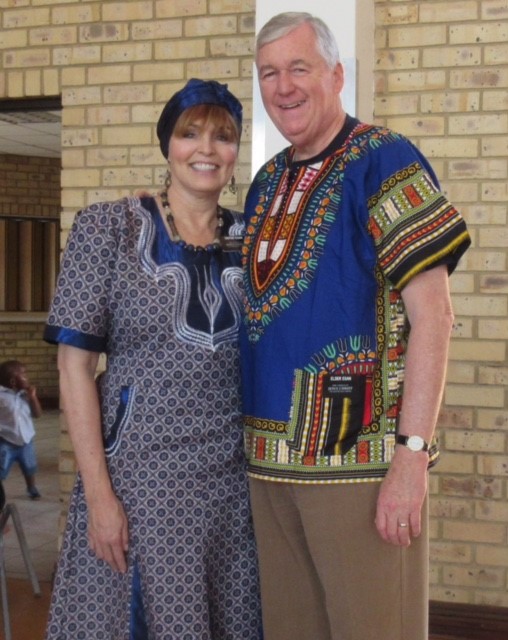
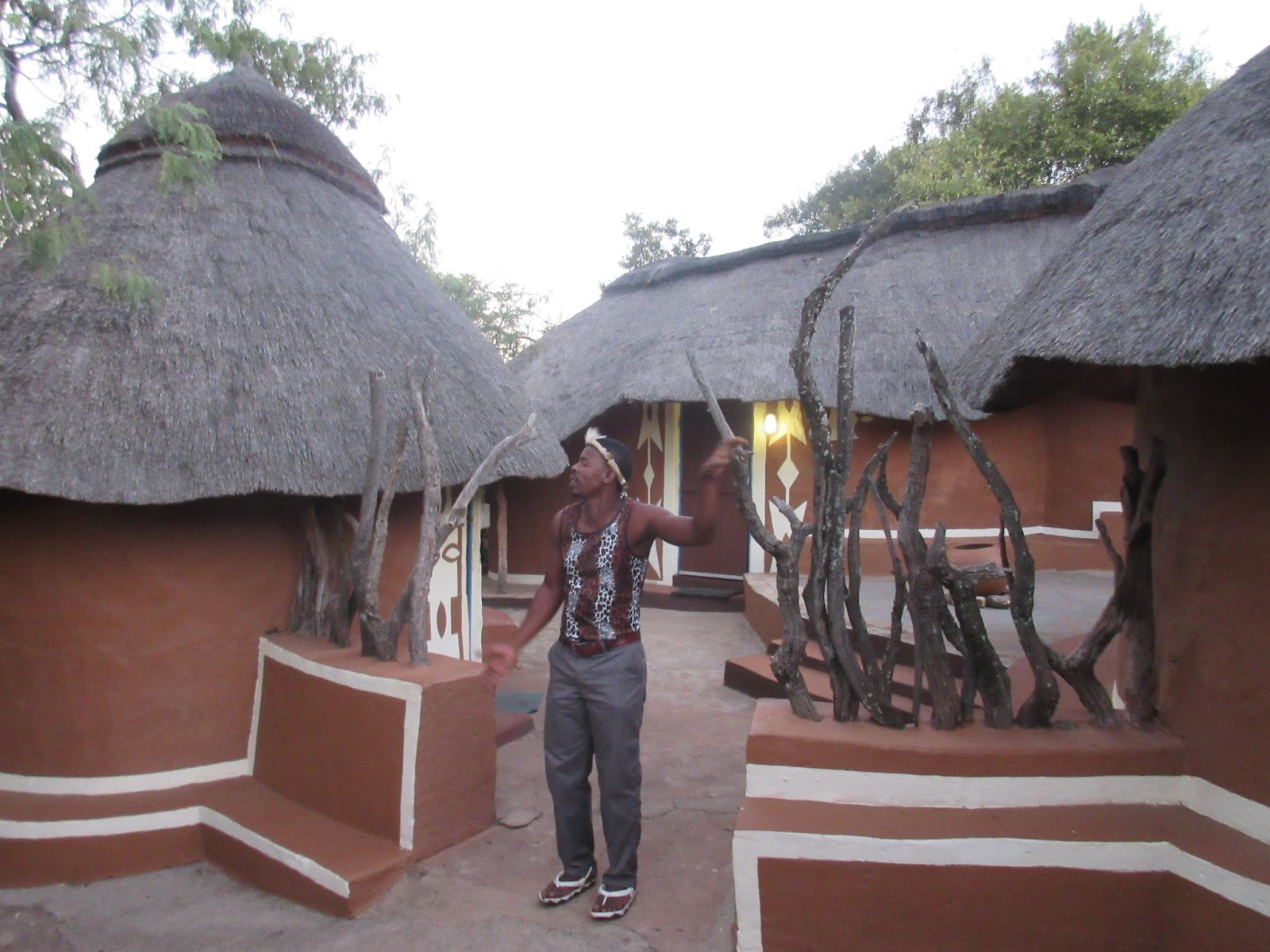
| Martha consults with a Zulu Chief at Nyama Choma in the Lesedi Cultural Village on Worker's Day |
This weekend was another 3-day holiday weekend, as South Africa's Workers' Day (Labor Day), traditionally on May Day (May 1st) fell on a Sunday and was celebrated on Monday, May 2nd. We attended the Saturday matinee of the BYU Young Ambassadors'
Heartsong concert at Wits University (10 minutes away). Then we made the 2 1/2 hour road trip to Pilanesberg National Park where we spent two nights and two days at the Ivory Tree Game Lodge and went on three safaris in the national park. On the way home, we stopped at the Lesedi Cultural Village in the Cradle of Humankind and enjoyed a fabulous drumming and dancing cultural performance and toured their Sotho, Zulu, Xhosa, Pedi and Ndebele villages, a fun and educational experience to say the least.
 |
Bob with his former missionaries, Cieron Faerch (left) and
Sipho Mothiba and his fiancée Gugu (right) at Wits Theatre
|
The BYU Ambassadors' Heartsongs: Melodies of Love was an amazing performance received by a unanimous standing ovation. The warm-up act was by the South African SABC choir, who sand both classical opera and traditional African numbers in brightly colored African costumes. Then the 20 Young Ambassadors came on with a colorful, fast-paced hour of outstanding song and dance numbers about love for a sold hour without a break. Very talented and very professional! We went with Sipho Mothiba and his (now official) fiancée Gugu Letsoalo, after a brunch at Mike's Kitchen. What a fantastic show!! We met another of our Cape Town missionaries, Cieron Fearch, there after the show.
 |
| South Africa's SABC Choir |
 |
| BYU Young Ambassadors |
|
|
The restaurant deck at the Lodge
|
 |
| The Ivory Tree Lodge pool |
The Ivory Tree Lodge is a beautiful facility, and our hut was spacious, nicely appointed, and very African, as you can see from the following photos:
|
|
| The Lounge at the Ivory Tree Lodge |
 |
| The Reception Lobby at the Ivory Tree Lodge |
We arrived at the Lodge too late for the first evening game drive, but made it for dinner. We did a 6:00-9:00 safari each morning plus a 4:00-7:00 evening safari the second night. We are confident we saw every road in the national park. Both mornings were very cold, and we were very surprised how few animals we saw, other than the antelope, wildebeests and zebra that were everywhere we looked the third hour of both drives. But our very uneventful first morning drive ended with a close encounter with the park's oldest elephant, a 55-year old 6-ton bull that stood in the road and dared us to try and pass. This giant elephant, named Amarula, is best known for a photo that went viral on the Internet where his front feet are on the roof of a VW Golf in the park. So our guide, Tracy, wasn't about to try and pass.


We waited from 8:45 until almost 9:30 while the elephant slept standing up and snored, hardly moving a muscle, and the cars backed up in a real traffic jam in both directions. Finally, after watching several vehicles turn around, Tracy turned ours around and took us back to the Lodge the long way, taking an hour rather than 15 minutes, so we didn't get back until 10:30 for breakfast.
We also saw five rhinos late in the drive including a mother and calf.
Between drives, we drove to nearby Sun City to see the amazing sights there around the opulent and exotic Palace of the Lost City Hotel, the Sun City Hotel, Casino & Convention Center and the Valley of the Waves water park. What a place! Very unique for Africa! Here are some photos of the resort:
 |
| The Palace of the Lost City Hotel in Sun City |
 |
| It looks like someone from Disney put together this amazing resort |
 |
| Sun City's central plaza with its monkey fountain at the entrance to the water park |
 |
| Valley of the Waves water park at Sun City |
 |
| Across the wave pool are water slides, including one that drops straight down |
 |
| Close up of the Temple of Courage water slide that appeared to be about a 75 degree drop |
We made it back to the Ivory Tree Lodge in plenty of time for High Tea and the evening drive, which was less than exciting until just before dusk, on our drive back to the Lodge when four huge lions, three lionesses followed by a male lion, walked right toward us on the road, crossed in front of our vehicle, and split up, about 50 meters apart, and surrounded a herd of impalas on their hunting expedition. It quickly got dark, too dark to get good photos, and was time to return home before they made any move toward their prey, but it was truly amazing to watch the pride set up for the hunt, seemingly oblivious to our presence. Tracy put a red filter on the spotlight as we watched the pride.
 |
| As it is getting dark, the male lion joins his lionesses in the impala hunt |
The next morning drive began with our finding three different lions, a young male and two young females resting in the grass next to the road. Lions sleep close to 20 hours a day and do all their hunting after dark during nighttime hours.


The whole experience at Pilanesberg National Park, the Ivory Tree Lodge and Sun City was phenomenal, but the holiday weekend wasn't over yet. We stopped on the way home at the Lesedi Cultural Village near Hartbeespoort Dam and enjoyed a very special and educational cultural experience, including a drumming and dancing program, a real African buffet dinner feast and a guided tour through six different villages representing six different authentic and alluring South African native cultures--Zulu, Sotho, Xhosa, Nguna, Pedi, and Ndebele much like the Polynesian Cultural Center in Hawaii shows villages from the different Polynesian cultures. Each village had its own version of round thatched roof huts with walls and floors of mud coated with cow dung, according to that tribe's culture, and we learned and used phrases in each language to communicate in the villages. Lesedi means "Light" in the Sotho language, and this was undoubtedly an enlightening experience!
 |
| The Lesedi performers do the Lesotho dance, one of five different cultures portrayed in song and dance to African drums |